Monday, December 11, 2006

The music "industry" - desparate & greedy

So, after years of suing teenagers on the grounds that they were protecting artists, the RIAA have decided that artists get too much. It seems that in the age of the corporation, creativity is something to be exploited in others. To be creative is to be exploited.

Yet, clearly there is a way to make money("Google's copyright fix", Business 2.0) out of supposed piracy. By essentially using your audience to market for you, you can cut the promotions costs and get a much clearer view of whether your newest creative venture will be a success, or, if it's looking bad, what your audience doesn't like about it. It means sacrificing control (attempting to determine taste) for faster reactivity to taste.

The RIAA's inability to adapt to this new business model can only be a reflection of the sham of modern music. Sure, there's creativity, but as soon as a genuinely good idea comes along, it is bludgeoned into blandness or marketed to death through repetition or copycat bands/songs. Art is about performance, and artists should be paid for performances, and should gain credit for their performances, not for some mass promotion machine.

Wednesday, December 06, 2006

Let my cell phone go

I always wondered what gave mobile telcos the right to lock my property - especially as I'm contractually bound to them for a period of time anyway. I appreciate why they want to do it (to bind the latest, coolest handset to their network), but what gives them the right? Well, as it now turns out, nothing: Cell Phones Freed! Poor Suffer? (Wired News):
"In the mid-1990s, big content providers were complaining that they couldn't distribute their work digitally if clever crackers were free to break Hollywood's digital rights management, or DRM, schemes at will. The DMCA was enacted to promote the digital distribution of content by making it illegal to circumvent DRM controls placed on music, movies and games. Since then, companies have repeatedly tried using the DMCA to quash unwanted behavior that has nothing to do with copyright infringement."

It seems that a new ruling has now preventing them from exploiting a protective law for their own gains.

Tuesday, November 28, 2006

It's all about the pixels

I've always been doubtful about camera megapixels. It reminds me of PC processor chip one-upmanship: my 2Ghz chip is twice as fast as your 1Ghz chip. It's nice to see some empirical evidence (Engadget) that dispels the megapixel impact.


I was also reading about HD TVs this week: apparently most HD TVs these days are interlaced, rather than progressive scan - that's what the 'i' is in 1080i (as opposed to 1080p). Again, it reminded me of the old debates about CRT monitors and refresh rates: people would go for higher refresh rates, without realising that the monitor switched to interlaced at higher rates.

So buyer of pixels beware.

Thursday, November 09, 2006

Zune: IPod It’s Not (NYT)

Ouch! Proof that even in the corporate world, money can't buy you everything. I'm not sure why Microsoft is going down this path. They could still win out, though, if the Zune software starts breaking iTunes, like they did to Realplayer with Windows Media player.

Tuesday, November 07, 2006

Ultimate gaming experience

Wow! Check this out for scenery. I've seen the old 12 screen flight simulators... all well and good, but why not just hop in a real plane? This is vista-vision fantasy world. Much more interesting!

Monday, October 30, 2006

Freedom Phones

It's easy to recognise how liberating mobile phones are, at a personal level. But what about their socio-political impact? Liberation technology (Economist.com) covers this very well, and summarises with a telling quote: “When the dominant institutions of society no longer have the monopoly of mass-communication networks, the dialectics between power and counter-power is, for better or worse, altered for ever.”


Then there's the economic impact: in this article the headline number is 1/2 million South Africans banking by mobile phone, in preference to (and mostly in absence of) cash or physical banks.

Thursday, October 26, 2006

Atheism as Extremism?

I've always felt that atheism is an oxymoron: a belief in non-belief. This article has convinced me otherwise. It looks at the extreme end of atheism: the people who think religion is a damaging virus that should not be tolerated. Dennetts comments are the most interesting, I think.

Macs should be made by Dell, says Gartner

I always wonder what analysts are thinking when they write this sort of summary. Are they really blind to the Apple brand equity, and their reknowned ethos of design perfection? Or are they looking too hard at the numbers? Or are they blithely applying history's magic brush? [Apple refused to license their early computers and got crushed by the burgeoning PC market].


Their assumption is that Apple are a software company, whereas most pundits assume the opposite: they are a hardware company, with the OS being a loss-leading differentiator. I prefer to think of them as more of a Nike: a brand representing a philosophy. The key for such a company is to set the tone of your market, whatever that may be, to maximise customer loyalty. Loyalists buy you because you're the best, and the 'cool factor' wows the initiates. Who assembles Apple computers? Who cares? Only Apple need to care because their brand assures the customer that they will receive a high quality purchasing experience. If Apple felt they could get a better production deal from Dell, I'm sure they'd happily bring them on board as long as it didn't diminish their brand.


To use a car analogy: Ford owns Jaguar, but Jaguars are not Fords, and never should be. [Ford tried that with the early X-type and it flopped].

Tuesday, September 26, 2006

Limewire's acidic response to the RIAA

It's about time someone struck back at the record companies' arrogant grumbling about pirates crashing their oligopoly. And finally Limewire has.

According to them the record companies

...have engaged in these unfair business practices for the specific purpose of eliminating sources of decentralized peer-to-peer file sharing and acquiring a monopoly over digital distribution of commercially valuable copyrighted music and movie content.


Sock it to 'em boys!

Thursday, September 14, 2006

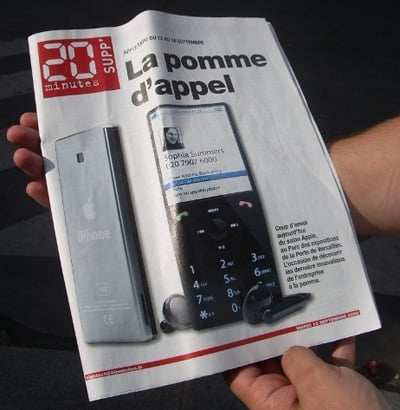
Apple iPhone - printed evidence?

iPhone newspaper image
There has been speculation about Apple producing an iPhone for years, ever since somebody noticed that www.iphone.com used to point to a page at Apple. There have been endless mock-ups, and every Apple event for the past 2 years has featured iPhone speculation in the pre-hype. This is the best evidence I've seen yet, although I question why they'd release it at such an (non-)event, and not with the new iPods & iTunes announcements this week.