
 Posts


We Brits are renowned for our self-deprecating humour. Foreigners think we have a great sense of humour, but I'd posit a couple of caveats to that: i) be prepared for us to use it on you, as well as on ourselves; ii) we can criticise ourselves, but don't you even think about it.
Now, when it comes to sport, even though we invented most of the big ones, we don't seem to have the stomach for it, in the professional era. Yet we do continue to produce talented individuals. It's always perplexed me when an England side have lost to a less talented, but better-prepared team. Is it something in our national psyche? I used to think it was our merciless media, who are notorious for sniffing out carrion.
This article has convinced me otherwise...
Thursday, December 28, 2006


Wednesday, December 27, 2006
50 things we learned in 2006
Quite amazing to see that we are still discovering some quite obvious things.
Windows Vista: whose rights are managed?
Here's proof, if ever it were needed, that the only security Microsoft has ever really been interested in is its share price. While this, in itself, is not a fault (every company has to pursue its own interests first to survive, and they aren't actually damaging the world), the fault is when they profess to be taking such steps "for the customer".
It's this sort of aggressive spin that makes M$ such a perennially 80's money-grabbing company.
It's this sort of aggressive spin that makes M$ such a perennially 80's money-grabbing company.
Sunday, December 24, 2006
History of religions in 90 seconds!
Interesting. Perhaps oversimplified, but interesting nonetheless....
Thursday, December 14, 2006
Monday, December 11, 2006
The music "industry" - desparate & greedy
So, after years of suing teenagers on the grounds that they were protecting artists, the RIAA have decided that artists get too much. It seems that in the age of the corporation, creativity is something to be exploited in others. To be creative is to be exploited.
Yet, clearly there is a way to make money("Google's copyright fix", Business 2.0) out of supposed piracy. By essentially using your audience to market for you, you can cut the promotions costs and get a much clearer view of whether your newest creative venture will be a success, or, if it's looking bad, what your audience doesn't like about it. It means sacrificing control (attempting to determine taste) for faster reactivity to taste.
The RIAA's inability to adapt to this new business model can only be a reflection of the sham of modern music. Sure, there's creativity, but as soon as a genuinely good idea comes along, it is bludgeoned into blandness or marketed to death through repetition or copycat bands/songs. Art is about performance, and artists should be paid for performances, and should gain credit for their performances, not for some mass promotion machine.
Wednesday, December 06, 2006
Let my cell phone go
I always wondered what gave mobile telcos the right to lock my property - especially as I'm contractually bound to them for a period of time anyway. I appreciate why they want to do it (to bind the latest, coolest handset to their network), but what gives them the right? Well, as it now turns out, nothing: Cell Phones Freed! Poor Suffer? (Wired News):
"In the mid-1990s, big content providers were complaining that they couldn't distribute their work digitally if clever crackers were free to break Hollywood's digital rights management, or DRM, schemes at will. The DMCA was enacted to promote the digital distribution of content by making it illegal to circumvent DRM controls placed on music, movies and games. Since then, companies have repeatedly tried using the DMCA to quash unwanted behavior that has nothing to do with copyright infringement."
It seems that a new ruling has now preventing them from exploiting a protective law for their own gains.
Tuesday, November 28, 2006
It's all about the pixels
I've always been doubtful about camera megapixels. It reminds me of PC processor chip one-upmanship: my 2Ghz chip is twice as fast as your 1Ghz chip. It's nice to see some empirical evidence (Engadget) that dispels the megapixel impact.
I was also reading about HD TVs this week: apparently most HD TVs these days are interlaced, rather than progressive scan - that's what the 'i' is in 1080i (as opposed to 1080p). Again, it reminded me of the old debates about CRT monitors and refresh rates: people would go for higher refresh rates, without realising that the monitor switched to interlaced at higher rates.
So buyer of pixels beware.
Thursday, November 09, 2006
Zune: IPod It’s Not (NYT)
Ouch! Proof that even in the corporate world, money can't buy you everything. I'm not sure why Microsoft is going down this path. They could still win out, though, if the Zune software starts breaking iTunes, like they did to Realplayer with Windows Media player.
Tuesday, November 07, 2006
Ultimate gaming experience
Wow! Check this out for scenery. I've seen the old 12 screen flight simulators... all well and good, but why not just hop in a real plane? This is vista-vision fantasy world. Much more interesting!
Monday, October 30, 2006
Freedom Phones
It's easy to recognise how liberating mobile phones are, at a personal level. But what about their socio-political impact? Liberation technology (Economist.com) covers this very well, and summarises with a telling quote: “When the dominant institutions of society no longer have the monopoly of mass-communication networks, the dialectics between power and counter-power is, for better or worse, altered for ever.”
Then there's the economic impact: in this article the headline number is 1/2 million South Africans banking by mobile phone, in preference to (and mostly in absence of) cash or physical banks.
Thursday, October 26, 2006
Atheism as Extremism?
I've always felt that atheism is an oxymoron: a belief in non-belief. This article has convinced me otherwise. It looks at the extreme end of atheism: the people who think religion is a damaging virus that should not be tolerated. Dennetts comments are the most interesting, I think.
Macs should be made by Dell, says Gartner
I always wonder what analysts are thinking when they write this sort of summary. Are they really blind to the Apple brand equity, and their reknowned ethos of design perfection? Or are they looking too hard at the numbers? Or are they blithely applying history's magic brush? [Apple refused to license their early computers and got crushed by the burgeoning PC market].
Their assumption is that Apple are a software company, whereas most pundits assume the opposite: they are a hardware company, with the OS being a loss-leading differentiator. I prefer to think of them as more of a Nike: a brand representing a philosophy. The key for such a company is to set the tone of your market, whatever that may be, to maximise customer loyalty. Loyalists buy you because you're the best, and the 'cool factor' wows the initiates. Who assembles Apple computers? Who cares? Only Apple need to care because their brand assures the customer that they will receive a high quality purchasing experience. If Apple felt they could get a better production deal from Dell, I'm sure they'd happily bring them on board as long as it didn't diminish their brand.
To use a car analogy: Ford owns Jaguar, but Jaguars are not Fords, and never should be. [Ford tried that with the early X-type and it flopped].
Tuesday, September 26, 2006
Limewire's acidic response to the RIAA
It's about time someone struck back at the record companies' arrogant grumbling about pirates crashing their oligopoly. And finally Limewire has.
According to them the record companies
...have engaged in these unfair business practices for the specific purpose of eliminating sources of decentralized peer-to-peer file sharing and acquiring a monopoly over digital distribution of commercially valuable copyrighted music and movie content.
Sock it to 'em boys!
Thursday, September 14, 2006
Apple iPhone - printed evidence?
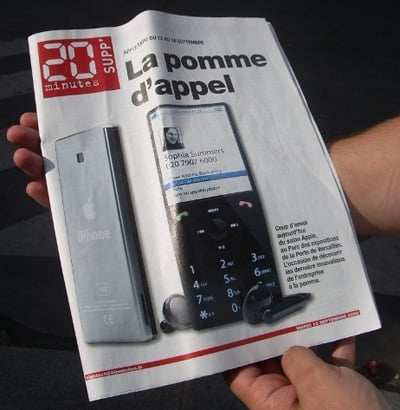 iPhone newspaper image
There has been speculation about Apple producing an iPhone for years, ever since somebody noticed that www.iphone.com used to point to a page at Apple. There have been endless mock-ups, and every Apple event for the past 2 years has featured iPhone speculation in the pre-hype. This is the best evidence I've seen yet, although I question why they'd release it at such an (non-)event, and not with the new iPods & iTunes announcements this week.
Royal Society archive: online and free..!
This is truly a national treasure, albeit only free until December. Here's a very interesting article reporting on the incredible talents of a certain young prodigy called Johannes Chrystostomus Wolfgangus Theophilus Mozart (what happened to 'Amadeus'?). Pretty fascinating as a contemporary and personal account.
Wednesday, September 06, 2006
Quantum Mechanics for dummies
I've never really grasped quantum mechanics. I know it's about quarks, qbits and probabilities, but couldn't really see where it fitted into normal mechanics. Finally, here's an explanation that I understand. Who'd have thought the humble surveyor's wheel was so vital to physics?
Friday, September 01, 2006
Crazy Origami
I can just about make a cup out of paper - a handy, pragmatic, boyscout thing to do. I remember at Uni the discussion about the mathmatical complexities of trying to write origami software. Well, it seems someone's done it, and the results are breath-taking. The dragon is particularly amazing - one piece of paper?!
Saturday, August 19, 2006
The face that launched my new life

The face that launched my new life
Originally uploaded by NeilSqueal.
I've seen loads of babies in my time, some even related to me, and
while I could appreciate their cuteness, I never really felt any
paternal pangs. Throughout Julia's pregnancy, I've wondered whether
it would hit me: that emotional override that makes even serious-
minded men act like fawning teenagers. Would I get that attachment,
that commitment to nurture this little life?
Looking at the picture above, you see a cute baby. What's the
difference to me and to you? Sure, Julia and I are responsible for
this little creature. But what has made me absolutely besotted by
this little warm bundle? I sit here at home, away from her (in
hospital with mum), and I can recall every aspect of her, from those
great big liquid eyes, to her smell, to the feel of her little weak
legs wriggling against a nappy change. I see my life's work. Not
just in the effort sense, but much like an artist probably sees their
greatest work: in terms of both accomplishment (it's made and
beautiful!) and potential (how will the world receive it?). The
trepidation is gone, and the bond is made, although I've no idea
exactly how or when it occurred.
The miracle of life is a cliche now. Science has dried it out, in
general. But the mystique of parenthood... that is really
something. Everyone tries to explain it, and many are willing to
impart their wisdom (often unbidden!), but there's no panacea. It
truly is an art.
Tuesday, August 15, 2006
Excellent summary of western leaders from ex-Telegraph editor
This is an article of an article that was originally written by a tory in the Guardian. Both are insightful summaries.
Monday, August 14, 2006
1000 ways to google
... well, eight anyway. They're quite intriguing, though. A good one is Toogle, which creates a colour ASCII image of your search term, made out of the letters of your search term.
Then there's Endgame that, effectively, uses Google Maps for a giant online multiplayer game of Risk.
And finally there's my personal favorite, Goggles which lets you fly a plane over Google Maps satellite images all day.
What a fantastic waste of programming talent... or is it art?
Friday, August 11, 2006
No wonder the collective noun for parasites is 'culture'
The first paragraph is a bit baffling, but after that this story is really quite mind-bending.
We know that fruit is simply a tastily elaborate seed dispersal mechanism - seeds are either bitter and therefore discarded, or passed through the mammal in faeces and sown with bonus fertiliser. But what's to say that parasites haven't adapted, in a similar way, to human intelligence?
Subtlely profound
I cn see why these additional OSX Leopard imporovements were not touted in the WWDC keynote. They would have bored every lay person to tears. That said, these are quite subtle yet fundamental tweaks. Gmail showed us the possible alternative uses of RSS by making your inbox an RSS feed, so embedding RSS features into the OS is a neat move. Same with iCal and addressbook. And enhancing the script-to-framework programming to Ruby and Python is excellent future-proofing - it means that whatever language or script you prefer, you can still use OSX natively. That said, it could also be a virus writer's heaven..!
Thursday, August 10, 2006
Hyped technologies for 2006 [printer-friendly] | The Register
This is one of these research companies' (Gartner in this case) better ideas: a prediction of where technologies are in terms of hype, rather than in terms of who is selling what this month. It's actually quite informative - especially in distinguishing between tectical and strategic implications.
Why Do They Hate the US?
I was pondering this question after watching the news, with all those angry people burning US flags, and after seeing a few of the recent photographic reminders of 9/11. This article is interesting, not so much for its insight (not much), but for it's reflection on peoples' perceptions - both US and non-US.
A film of protesters in a street burning a US flag seems to have more impact (on me at least) than asmall scrolling headline reading '30 US soldiers killed'. That spin plays to the western sensibilities well: insane savages rioting and killing mumblecoughmumble soldiers. Cause, effect.
King Abdullah I, in 1948, on the creation of Israel."What would your answer be if some outside agency told you that you must accept in America many millions of utter strangers in your midst—enough to dominate your country—merely because they insisted on going to America, and because their forefathers had once lived there some 2,000 years ago?
Our answer is the same.
And what would be your action if, in spite of your refusal, this outside agency began forcing them on you?
Ours will be the same."
Wednesday, August 09, 2006
Another year, another Mac OS - well, partly
This (Macworld) is a nice article that sums up my thoughts on the latest Steve Jobs show. It covered a few of the new OS' features,, but with an emphatic, not to say cryptic, caveat (see linked article).
I also liked his final comment:- "And besides, it’s a testament to Apple that they routinely produce products that are worth speculating about. When I get a new Microsoft product in the mail it’s often like that moment when you’ve got both feet on the brakes but you know that the car can’t possibly stop in time. You don’t know what’s going to happen. You just hope it won’t hurt too much."
Monday, August 07, 2006
Leopard: purring, rather than roaring
The notable aspect of today's sneak preview of Apple's next OS was what was hidden. They were at pains to point out that there were bigger features that they wished to keep secret, to prevent Microsoft photocopiers whirring.
The more I think about this (see last post), the more I think Apple have the right angle: they're putting the 'personal' back into personal computing. They're driving home the idea of their boxes being specialist media manipulators. As media becomes ever more digital, especially at the personal level, these tools increasingly become as indispensable as the gadgets they supplement - the glue between your camera, your music collection, your video and whatever network you want to communicate over.
The more I think about this (see last post), the more I think Apple have the right angle: they're putting the 'personal' back into personal computing. They're driving home the idea of their boxes being specialist media manipulators. As media becomes ever more digital, especially at the personal level, these tools increasingly become as indispensable as the gadgets they supplement - the glue between your camera, your music collection, your video and whatever network you want to communicate over.
What's especially poignant is that these feature all require rock solid hardware at the client end, unlike office applications that can be (and are increasingly) run over a network from a central server (eg. webmail).
Sunday, August 06, 2006
The future of the OS
I've just been looking at YouOS and Goowy, two of the latest, free, online personal OS offerings. YouOS, in particular, has come a long way in the year since I last looked at it.
Which leads me to conclude that the next mainstream OS will not be desktop-based. It will be hosted by central servers. Consumers' security concerns can be alleviated by tight integration with keyfobs, and possibly a light, encrypted local instance of the OS running on linux (maybe even on the keyfob).
The enterprise OS is a different story: the winner there will not necessarily be the most technologically advanced, but just the one who wins the skillset wars.
Where are the tech dev skills? Somebody give me a Google Earth overlay of tech dev skills: geography and skill type. That will lead to the next paradigm.
Finally, a convincing Human-Computer interface
I've seen loads of HCI ideas over the years, from 5 finger typepads, to voice commands. All are, in my view, flawed because they require different types of intuition - there is still something that has to be learned. It's like asking two different people to sort a pile of random papers. Without further instructions, they are likely to sort it in different ways: one might choose colour-coding, the other alphabetic. The amazing thing about this video is that this technology is not sci-fi, yet it is incredibly intuitive. It's tactile, and while the sample applications are good, the possibilities in research, design, gaming - everything beyond typing, basically - are mind-boggling.
Thursday, August 03, 2006
Wednesday, August 02, 2006
E-rope: saving the planet one socket at a time - Engadget
 This is genius, as in one of those ideas that, once you see it you wonder how you didn't think of it. Actually, I'm sure I had atoy like this as a kid...
Monday, July 31, 2006
Digital animation - the next step

I suppose it was only a matter of time, but it's impressive nonetheless: this new image capture method gets the detail that motion capture misses. Think of the applications and mis-applications: faking news, real news involving "Face Off" incidents, porn...
The old 'thief pretends to be policeman' scam goes online
I suppose it was only a matter of time, but what's interesting about this (The Register) is the difficulty they seem to be having in stopping it. A 'hardened' server in China? That's the trouble with freedom, I suppose: it doesn't have a conscience.
Wednesday, July 26, 2006
Web radio - roll your own station
I had heard rumour of this site, but the interface still blew my mind. A real inspiration..!
Tuesday, July 25, 2006
A great quote about songs
Words make you think a thought. Music makes you feel a feeling. A song makes you feel a thought. --E.Y. Harburg (Edgar Yipsel) (1898 - 1981)
There's a childish simplicity to this which is quite beguiling.Clearly only to be ascribed to the best songs, rather than any old Pop Idol karaoke.
Friday, July 21, 2006
Mr. Comics Talks Comics
Scott McCloud is a unique commentator on the art form, in that he practices what he preaches, and demonstrates the versatility of the medium while simultaneously explaining it. In short, he's a guy you listen to. So, have a read.
Thursday, July 20, 2006
How languages evolve - hilarious
Don't ask me how I found this, but some of the words (lower down the article) are hilarious. I particularly like the word/phrase for a piano.
Chinese mini-landscaping
You've got to wonder who scours the earth looking for these things, but this really is rather extraordinary. It looks so accurate that one can't help wondering whether it's a Google Earth imaging glitch, rather than some giant landscape model.
Wednesday, July 19, 2006
Google power!
Most people know that Google Search is not just a search engine, but this quick reference really does demonstrate, at a glance, that Google really is a powerful command line interface for the Internet.
Thursday, July 13, 2006
English sport - a victim of circumstance
I think every Englishman wonders, after yet another sporting disappointment, what is wrong with English sport? Why can't we win on the big stage? Or at least, if we do, why can't we do it consistently?
Lots of people lament the manager, the player choices, the team cohesion, but few reflect on the infrastructure. This article seeks to address this in the football context, but I think it is equally applicable for British sport on the whole. There's something in the British psyche that thinks sporting professionalism is almost cheating. We love the have-a-go hero. We appreciate the valiant effort more than we lament the obvious lack of preparation. Good old British pluck. And when we lose, we blame circumstances: the weather, the opposition, the players, the manager. But never the institution. We never ask the question "what does it take to win?" and gear our sport/nation for that. Rather, we just hope that next time circumstances will be more fortuitous. Unfortunately, in modern professional sport, luck is no longer found but made.
Friday, July 07, 2006
Interesting take on Net Neutrality from a guy who knows
There's been much in the press about net neutrality - often more opinion than fact. In this article Peter Cochrane, in his excellent paedagogic style, manages to inform about the facts and the issues, and express his opinion - all quite succinctly. And here's a guy who knows all about this topic.
Saturday, July 01, 2006
Another very english exit from the World cup
As ever, controversy, more than sportsmanship and skill were the features of England's exit from the World cup. I'm actually getting disillusioned with professional football. In most sports, the quality and flow of play improves the higher the tournament. The people at the top of the game are superlatively skilled, and it is this skill that separates them. Not so in football, where forwards with the balance and poise of cats can suddenly collapse in a penalty area. And where it is acceptable for players to scream and swear at the referee.
The trouble with football is that it rewards weakness: the more a foul is played up, the more chance of getting a free kick. Also, the game/industry pampers the players - deceitfulness is acceptable, as long as you don't get caught. Hardly role-model stuff.
So how does one discourage such behaviour? Well, rugby has a much greater propensity for violence, yet in that sport the referee's word is law. Players cannot even talk to the ref, except via their captains. And if there is a serious infraction, rather than it effectively deciding the game (eg. Rooney's sending off this time, Beckham's 8 years ago), they are sin-binned for 10 minutes. That's what football needs if it is to become an exemplary sport rather than merely the simplest and most popular.
Friday, June 30, 2006
The Periodic Table of Poetry
Poetry and science rarely mix: science prefers physics to metaphysics. Which makes this site quite a gem. I was expecting cheesy limericks rhyming gold with old, but these are actually quite profound & thought-provoking - right to the brink of pretentious twaddle. Nice to dip into once in a while, and if I find a decent one, I'll repost here (cited appropriately, of course).
Thursday, June 29, 2006
A good summary of the web revolution
I've read much hype about the internet and 'web 2.0' over the years. Most describes it as techie utopia and cultural phenomena (both good and bad). Here's a bit more, but it gets to the essence of the web - that it is, increasingly, a social phenomenon rather than a technical one.
The industrial revolution isn't remembered for its machines, but for the way it shaped society: migration from countryside to cities, merchants/industrialists superceding aristocracy in wealth, the birth of the modern corporation. This article provides a hint of how the early days of the web many be remembered in years to come.
Friday, June 23, 2006
World Cup tech
Here's an interesting insight into what goes into (and out of) planning the tech infrastructure for a World Cup. I like the stats:
20 terabytes of converged voice and data traffic - or enough to fill 5,120 iPod Nanos at a rate of 170 per dayI wonder if that will become a standard measure as these sort of events evolve? "That was an 8,000 iPod event, that was!"
Newport to Bermuda race - they've arrived!

Newport to Bermuda race - they've arrived!
Originally uploaded by NeilSqueal.
Snapshot taken on the commute into work - thank god for traffic..!
Wednesday, June 21, 2006
Firefox Extension primer
Have Firefox, will extend. I can't think of what I'd want to write and extension about, but it's useful to know what's involved. Stops me getting out-Xuled or over-chromed by techies...
Sunday, June 18, 2006
An Open game console? Bring it on.
The GP2X is shaping up to be a nice piece of hardware for those who are tired of the proprietary games consoles and their expensive games. Neat features include running on Linux, the use of USB 2.0 and SD card technology and the ability to play everything (movies, photos and games) through a TV. It evens has emulators for most legacy consoles and the games are free.
All it needs to annihilate the competition is WiFi.
Icing on the cake? All of this costs a mere £125 - haven't you got one yet?
All it needs to annihilate the competition is WiFi.
Icing on the cake? All of this costs a mere £125 - haven't you got one yet?
Tuesday, June 13, 2006
View from Lawrence & Nic's

View from Lawrence & Nic's
Originally uploaded by NeilSqueal.
Captured by phonecam... Shame I didn't have a better camera...
Interesting perspective on the Blackberry's future
I've never been a Blackberry fan. They seem to lack a personal touch, which I suppose is why corporate IT like them so much.This review (Mobile Tech Review) suggests that they may even be at risk in that area: "Research in Motion have again evolved the BlackBerry. There's no denying that this is a better BlackBerry than yesterday's, even with the dreadful construction quality. I'm going to assume that the next BlackBerry will rectify that backward step. I am fearful for research in motion and their future though, I don't think that they are evolving fast enough; I think this is a good product but it is a year old already.
In the enterprise market the BlackBerry still has a solid and faithful following but in the company that I am responsible for I have already replaced BlackBerry with Pocket PC and the reason for that comes down to the exchange server that I run, my Pocket PCs, smartphones and PalmOne Treos can synchronize with exchange directly, they don't need the costly BlackBerry Enterprise Server to help them out. By choosing Pocket PC over BlackBerry I'm just saving money, improving reliability, adding features and cutting out another step that I must provide and support, it's as simple as that.
If you're a BlackBerry die hard you'll like this new model but if you're a pragmatist I think you might conclude that the rest of the world has overtaken the BlackBerry. RIM, we thank you for the Push email; we’ll always remember you for that."
A Decent Apple Synopsis
This seemed a useful article to post as it contains most of the material which technocrats tend to argue on when the subject of Apple rears its head. Essentially it argues that biggest is not always best (a mantra used far too often in the industry) and that, just because you don't dominate a market, you are not going to fall under capitalist pressure.
Friday, June 09, 2006
America and the World Cup.
It's always intrigued my why Americans don't do football - the biggest sport in the world. I've always put it down to arrogance - the usual US reticence to muck in with johnny foreigner. While this article acknowledges that line of thinking, it also offers some additional and intriguing reasons.
Tuesday, June 06, 2006
Google Office?
They've already bought Writely, which is an online wordprocessor (v good one, actually - it even does PDFs). And, as the link above shows, there's a spreadsheet imminent.
Begging the corporate question: what's an OS? That's so 20th C, man. Soon it will only be multimedia that requires an OS (ie. heavy processor/network stuff), and which OS would you choose for that? (Hint: check out these Final Cut Express demos)
Here's the question, though: how does this web app directly make revenue?
Google ads on the page? That's fine for a search results page, but for a productivity page? Imagine if Microsoft did banner ads in Office. Putting aside the outrage from license paying customers, I suspect it might bug your typical office drone too. So, what's the alternative? Charging for it? Come on, this is Google. They're the nice guys who give great stuff away for free, and you can even earn money from them. They can't charge us, or we'd boycott them, like the spoilt websurfers we are. So... maybe there's no direct revenue. Maybe it will all be funded from search page ad revenue. It certainly seems to be how Google Calendar is configured. Not sure how that will fly with investors. It certainly doesn't make much business sense: you want to keep the revenue as close to the costs in a diverse portfolio like Google's. So, what's the plan guys?
Monday, May 22, 2006
Crazy aviation
Physics says why not? Why not pour a cup of tea whilst performing a barrel roll in an aircraft with the engines off?
Common sense says you're barmy. But then common sense is actually not that common, really, is it?
Common sense says you're barmy. But then common sense is actually not that common, really, is it?
The Mis-interview
I can't believe I'm actually linking to the Daily Mail, but it is a good summary, with video, of this hilarious incident at the BBC. Bless the chap for soldiering on and not causing embarrassment.
Wednesday, May 10, 2006
Anti-virus Schmirus
This article just goes to prove my belief that some anti-virus vendors are like dentists who own doughnut shops: a dichotomy of complementary goods.
"Heard about these nasty viruses? Don't worry, guv, we'll protect you...for an unlimited subscription fee, naturally."
I wouldn't be too surprised to find that these unscrupulous vendors are writing these viruses, especially the ones which "aren't in the wild yet".
Only now McAfee have been caught short trying to tout to Apple users who tend to be more discerning than their PC brethren and who also know when the statistics don't add up. I'm sure it won't be long before Apple's new-found popularity with PC users will mean that their products finally succumb to the pandora's box that is the computer virus -- let's just hope that Apple can shoe-horn AV into OS X (as Microsoft is rumoured to be doing with Vista) before vendors such as McAfee and Norton start circling and demanding their pounds of flesh.
Tuesday, May 02, 2006
High-tech good ol' fashioned retail
Hearing so much about high-tech companies making millions out of selling on the web, it's easy to overlook this instance (Wired News) of a high-tech going the other way, or, as they would put it "thinking different".
Having visited half a dozen of these stores myself, I can vouch that it's definitely more than merely displaying goods & selling them. They all seem to have an atmosphere more like a very sophisticated hobbyists club. I've always wondered, though, whether they were bearing fruit for Apple, or whether they were expensive loos-leaders/follies. The stats in the article are impressive, although the analyst's (singular) prediction is interesting...
Monday, May 01, 2006
Treo 650 ROM Tool - finally!
Even with memory cards, internal memory is still premium space on PDAs (reminds me of the old main memory/XMS/EMS issues with DOS!). Because Treo's are phones, they're even more full of clutter: language files and network/vendor tied software that has been superceded by 3rd party stuff (eg. TCPMP and/or Pocket Tunes beat Realplayer hands down).
There was an earlier tool by a guy called Shadowmite that did a reasonable job, but Palm clamped down on it after they received too many support calls from people who tried & failed to use that tool. Now there's a new ROM Tool that promises to be more user-friendly and more repairable.
Wednesday, April 26, 2006
When Google & Firefox mesh...
Gmail is magnificently subtle, from the fact that it's invitation only to the elegance of the interface (threaded discussions, rss, address autocomplete etc.). Even its revenue model is subtle - those discrete text ads, rather than irritating, big, blinking flash banners. Then there's the storage space.
I'd seen a 3rd party tool for using all that Gmail space as online disk space a while back. Trouble was, it needed to be installed on the client and there are separate vendors for the mac and PC versions. Then some bright spark made Gmail Space - an add-on for Firefox that allows you to use spare Gmail space as file space. Nice!
Update: so you have to install the Firefox extension on each machine, right? Not with Firefox Portable.
Monday, April 17, 2006
A study of open-source business
This is a fascinating article (Economist.com ) about the pros & cons of open source, not just s software, but as a system of organised work.
Wednesday, April 05, 2006
Doublethink Different
This (Wired News) is an excellent comment about the state of Apple computers (small c) today. I'm not a rabid mac fan, but I admire the way they try to please their consumers - often by pushing the design/usability envelope. The possible irony here is that if they do go after corporate customers, they could lose that consumer-pleasing, user-friendly focus.
Tuesday, April 04, 2006
Sunrise from balcony

Sunrise from balcony
Originally uploaded by NeilSqueal.
My first assignment finally complete, it feels like a new dawn..!
-----
from my Treo wireless handheld
Monday, April 03, 2006
Paul Allen and Microsoft
It could almost be out of a film, except this one doesn't have a happy ending... yet. That's not to say Paul Allen is a victim - he's done rather well. But it's sad that the bad guys apparently win. This helps to explain why they (Gates & Ballmer) loathe open source software so much.
Friday, March 31, 2006
Those were the days: Bill Gates promoting Apple
Who'd a thunk it? But here's the evidence. Recognise that skinny guy in the blue shirt..?
Thursday, March 30, 2006
A Brief History of Microsoft FUD
This article is a well-researched piece about Microsoft's various attempts to unseat Linux. What better proof that MS are a bigoted monopoly, than the fact that their only serious OS competitors in the last 10 years give their products away for free?
Thursday, March 23, 2006
UK traffic info map
Here's a nice mash-up website: it takes BBC traffic news and x-refs it with Google Maps. Grouped by county & very clean looking. Not sure how up to date it is, though.
Thursday, March 16, 2006
Idea: camera for Video iPod
WHile reading this article, particularly the specs of the Broadcom chip, I was struck by the prospect of a camera for the Vipod. It could simply be a scaled-down version of the iSight that attaches to the port at the bottom of the Vipod and runs width-wise along the bottom of it.
Video podcast-tastic, eh?
Wednesday, March 15, 2006
MacIntel... MacInDell?
My first thought on news of the Intel-based MacBook was that this might be a tacit swipe at Microsoft's Windows market. Sure, it's a nice new Apple laptop, but the argument for Intel chips seemed a little, well, technical for Steve Jobs. Better chip efficiency?? You could hardly imagine the world's graphic designers salivating in anticipation. I thought it was either a consolidation move, after IBM managed to woo Xbox and Playstation with their new Core chips (afer all, what priority would they give Apple after megadeals like that?), or maybe the chip efficiency was important for a possible expansion into more mobile technologies.
This article (extremetech.com) puts an interesting angle on the OS competition, although I'm not sure if Dell have the clout, or the legal leeway to be able to offer other competing OSes. I hope they do, though, if only to sharpen Microsoft up a bit.
Friday, March 10, 2006
A definite glimpse of Web 2.0: Zoho Writer & Pageflakes
I keep seeing articles about "Web 2.0" and people waxing lyrical about AJAX. While the examples always impressed (Google Maps being the most obvious), I couldn't help feeling that we should have had this all along; that the early HTML, static web was a regression in UI standards for the sake of connectivity. I mean, people have been enjoying incredible shared worlds online in games like Unreal Tournament for years now, so why all this fuss because finally some web pages can handle ansynchronicity? While the examples are whizzy, they've hardly been "every day" practical, unless you're a geography teacher or a news hound.
Until now. I spotted a simple, plain ad for Pageflakes on Digg, and was intrigued enough by the beautifully simple interface and lack of bandwidth-sucking ads to try it. Verrry nice, and with the decent array of widgets, lots of potential. But while those widgets were neat, they weren't, again, productive. A news reader (got one), an addressbook (got several), a clock (??) etc. So, demo stuff, essentially.
Then today I spot a new widget: Zoho Writer - the online word processor. Yet another WYSIWYG 'inline' text editor? Well, yes. And much, much more. Going to the homepage, I tried the demo user. Import your Word docs, export Word, PDF, HTML, to your blog, to email friends (as link or shared doc that they can edit too). Save docs online, save templates online. And all integrated into Pageflakes, making the latter, with my iCal widget and my Gmail widget, start to look like a handy, access-anywhere desktop.
Google, buy these. NOW.
Update (3rd April): It appears Google have already bought one!
Thursday, March 09, 2006
Test photo from phone via Flickr

Test photo from phone via Flickr
Originally uploaded by Taggweb.
It may work, it may not, but here's a pic from my office window today - the first sunny day for about a week
-----
from my Treo wireless handheld
Boffins produce plasma at two billion kelvins | The Register
Any facility with a remit of (deep breath)"new experimental environments to help validate computer codes responsible for maintaining a reliable nuclear weapons stockpile safely and securely" sounds suspiciously like a stupidly expensive boffins' dosshouse. Sure enough, look what crazy science they've managed this week. And, like reality TV wannabes, they seem to have stumbled into some kind of breakthrough. Crazy...
Wednesday, March 08, 2006
Text messaging discovered in US!
This is a question I've often pondered myself, having received quizzical looks from Americans in the past regarding the topic of text messaging. Why don't they get it / use it / exploit it like they relentlessly exploit every other communication medium? Finally, this article (Economist.com) explains why.
I wonder how long before they're touting their "new discovery" to the rest of the world..!
Sunday, March 05, 2006
E-Ink - the Tablet Revolution
E-Ink, I predict, will be one of those inventions that will just invade everyone's life eventually, as mobile phones have done. It consists of microscopic black beads of ink suspended in a white liquid which rise to the surface when a current is passed through them - only when the current is switched off, the image remains. This has the added effect of producing something readable in any light and using no power except to change the image.
Seiko, the inventors, will initally launch a watch with the technology, but soon it will extend to book readers (backed by such authors as Dan Brown) and even bill boards and price tags in supermarkets (Tesco has plans to use it). Imagine passing down an isle with your (RFID'd) Clubcard in your pocket and watching the prices change just for you!
Once colour is introduced, it's only a matter of time before all printed material is superceded by this technology, with editions wirelessly downloaded and pages changed at the touch of a button.
Friday, February 24, 2006
The greatest US president
Lincoln is one of those people whose quotes appear (to me anyway) in the broadest of contexts, yet they are always aptly profound and beautifully expressed. The wisdom of Solomon and the literacy of Dickens: who could want more in a president?
Here's a great quote I found in the article linked above. At the time, Lincoln was only a Congressman, and opposed to the U.S. war on Mexico — a country that had never attacked the US. Lincoln said as follows: “Trusting to escape scrutiny, by fixing the public gaze upon the exceeding brightness of military glory — that attractive rainbow, that rises in showers of blood — that serpent’s eye, that charms to destroy — he plunged into war.”
Worthy of Shakespeare...
Wednesday, February 22, 2006
Macs not 100% secure shocker
After much news about the mac vulnerabilities exposed over the last couple of weeks, it's nice to finally find an article (Wired) with a sensible perspective.
Let's face it, these things happen to Windows at least a couple of times a week, and that's not big news. Nor are these issues 'exploits' - merely vulnerabilities, with published remedies. I still don't have to fear malicious VB script files in my email, like Windows users. Nor do I have to worry about dubious pop-ups in my browser, like Windows users. Even if I did manage to foolishly download a dodgy file, the chances are it would be a .exe file, which OSX can't run.
So, Mac vulnerabilities a big deal? In themselves, no. In the fact that macs are vulnerable? No - of course they are. In the fact that security people deem them worthy of examination? Yes, it finally means that people are taking them seriously.
Friday, February 17, 2006
Security is a culture thing, not a technology thing
The best security in the world, beaten by human curiosity and the promise of something for nothing.
Need to crack a company's network? Just hand out free CDs to every employee and, chances are, you will strike gold and someone will load your code.
And to think that most corporates invest huge amounts of time and money trying to implement computer security...
Need to crack a company's network? Just hand out free CDs to every employee and, chances are, you will strike gold and someone will load your code.
And to think that most corporates invest huge amounts of time and money trying to implement computer security...
Friday, February 03, 2006
The rise & stumble of Google
This is an interesting article: Gunning for Google (Forbes.com); it has a pretty well-balanced view, which you'd expect from Forbes.com, although the reserach from a similar Economist article was more thorough. For instance, The Economist noted that Google's foray into China was a sensible capitulation (what would have happened to their share price if they hadn't?) and that their non-censored chinese site, outside China, would still run. So they weren't taking anything away from their chinese audience, they were simply adding a restricted version. Better than nothing at all. Also, those accusing Google of selling their soul chose to overlook Google's resistance to the DoJ demanding their data.
One revealing quote from the article (Forbes, not Economist):
One revealing quote from the article (Forbes, not Economist):
"Google was headed for a fall, if only because, damn it, we’re all so jealous. It went public at $85 in August 2004. At over $400 lately, it has created four billionaires, and according to the company, one in five of its employees are now multimillionaires. (The investor relations chief, who has got to be younger than I am, is said to have recently retired.) Sergey Brin and Larry Page, each now barely into their 30s, founded Google in 1999 after landing a $100,000 check at lunch from Sun Microsystems (nasdaq: SUNW - news - people ) co-founder Andrew Bechtolsheim. Now Brin and Page are worth $16 billion apiece. Isn’t that reason enough to hate them? "
Altruism or Capitalism?
The sub-$100 laptop is coming, but are the implementors doing it out of a sense of altruism or for some other less-laudible reason? Also, note who the potential implementors are -- not faceless corporates, but businessmen in the top of their markets.
I think this article shows the right sense of skepticism and hope and I especially like the reference to free mesh networks - information freedom at very little cost just by taking up the slack that the telcos don't worry about.
The key to all of this is to find the method that will cause the least pain for the greatest gain; something that the sub-$100 laptop is trying to publicly prove can be accomplished.
Tuesday, January 31, 2006
A lot of effort for a tiny reward (Neutrino News)
How does one detect a neutrino? This (New Scientist) looks like one of those hippie physicists visions.
Dude, I hope it works, otherwise that's an awfully big and cold money pit...
We need, like, a biiig bucket, man. And it's gotta be in ice. So, we, like, dig a huge hole, maybe 1km wide by 2.5km deep, in, like, the south pole. Yeah! Then we put some really sensitive sensors in there, and wait for... uhm, I dunno, like, maybe a decade or two?
Dude, I hope it works, otherwise that's an awfully big and cold money pit...
Sunday, January 29, 2006
Here be Search Dragons
In the early days of global exploration, maps changed frequently - annually, even - and the areas that were unknown were embellished, for want of any other content, with pictures of dragons and other vaguely daunting sea creatures. Perhaps to placate the exploratory egos of their audiences - so that's why you didn't sail there.
In these early days of internet exploration (the exploration of global ideas, rather than just geography), it's ironic to note that the dragons still exist (Economist.com). It's very reassuring to see a fast-growing and intrepid company like Google behaving with such consideration and responsibility to the true ethics of a free market. If the internet has one objective, as an entity, it must be that of perfect information.
Friday, January 27, 2006
Internet Security from a biostatistician's point of view
Fascinating look at internet security with special regard to the dangers of monopoly in an interconnnected world.
Tuesday, January 24, 2006
Macworld: Secrets: Launch your Mac
With any OS update there are always gems and, like the best jewelry, the best are often the smallest. Case in point: Mac OS X Tiger's launchd command. One little command that yields so many options. Macworld: Secrets: Launch your Mac shows us a few samples, and a useful frontend for it.
Monday, January 23, 2006
Nintendo DS for something useful
Finally all that cute, intriguingly useful hardware may be put to good use, by this. The pretext is for using your DS as a game controller for your PC/Mac, which is a good enough idea anyway, but to do this job it has to detect the associated wireless network. Any wireless network. So it's a useful, handy network scanner too.
Wednesday, January 18, 2006
Arounder - Travel and Lifestyle in 360-degree Quicktime VR - Virtual Reality Full Screen panoramas: lugano, milan, milano, barcelona, monte carlo, rom
Now, this (Arounder.com) impressed me. I've seen Quicktime VR pictures before, but not of such excellent places. Also, the site itself is very well laid out, with maps and descriptions and no clutter. Strangely, I found myself appreciating the beauty of these places even more than when I visited them.
Wednesday, January 11, 2006
Apple at the crossroads.
Should Apple Open Up? This interesting article from Business Week discusses the options available to Apple, now that they've unveiled their first foray into the Intel world. I often ponder Apple's strategy because, unlike all the other computer tech companies, they don't like to pander to corporates. In fact, if you believe their branding, they don't like to pander at all. Rather, they like to fulfil the wishes you haven't even thought of yet. But are they the Mercedes to Microsoft's Ford, or are they the Maserati to Microsoft's BMW? The crux comes down to whether the Intel Macs can crack the mass consumer market. Their bid is to ride the digital consumer wave: digital audio leading to digital photos, video and all the sharing enablement that the internet provides. Domestic digital media management, basically. The question is, do most people really care? Apple always runs the risk of being too slick for the mass market...
Monday, January 02, 2006
Red Herring's Top 100 Small-Cap: Computing
These companies should be interesting to watch over the next year. Not just from the money perspective, but from the technology direction perspective.
Subscribe to:
Posts (Atom)